
Research Unit RING
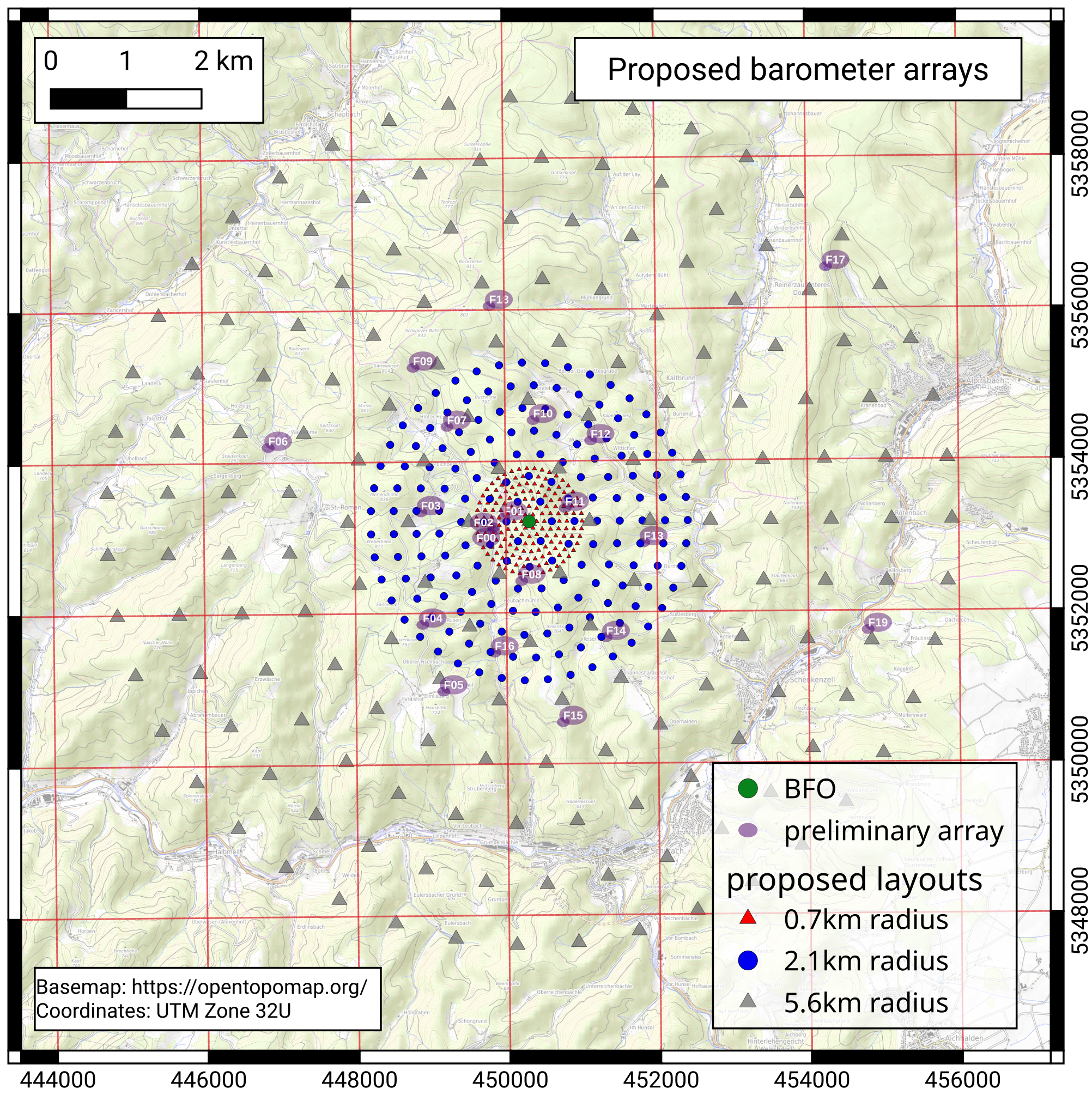 Within the Research Unit RING we will carry our ambitious research within the project on ’Environmental effects on long-period rotational measurements’. A large-N array of autonomous barometers will be deployed in the vicinity of Black Forest Observatory (BFO). Some stations already operate in the field (see the map). From the such obtained data parametric descriptions of time-varying lateral gradients of air-pressure shall be derived. These gradients contribute to crustal deformation. The local rotation of sensors in the observatory is sensed as tilt-coupled gravity and shall be explained in a deterministic way by the barometric time series. In the long run this shall help to mitigate locally induced noise in rotation measurements.
The research is based on long-standing investigations of how unrest of the atmosphere can cause disturbances in long-period recordings of acceleration and deformation. The two most relevant publications with respect to the current project are:
- Zürn, W., T. Forbriger, R. Widmer-Schnidrig, P. Duffner, and A. T. Ringler (2022). Modelling tilt noise caused by atmospheric processes at long periods for several horizontal seismometers at BFO — a reprise. Geophys. J. Int., 228(2), 927–943. DOI: 10.1093/gji/ggab336
- Zürn, W., J. Exß, S. H., C. Kroner, T. Jahr, and M. Westerhaus (2007). On reduction of long-period horizontal seismic noise using local barometric pressure. Geophys. J. Int., 171, 780–796. DOI: 10.1111/j.1365-246X.2007.03553.x.
- Brotzer, A. (2025). The ROMY ring laser array for seismology: Instrumental characterization, low noise limits for rotations and seismological applications (Doctoral dissertation). Ludwig-Maximilians-Universität München, Germany.
- Brotzer, A., Igel, H., Stutzmann, E., Montagner, J.-P., Bernauer, F., Wassermann, J., Widmer-Schnidrig, R., Lin, C.-J., Kiselev, S., Vernon, F., & Schreiber, K. U. (2023). Characterizing the Background Noise Level of Rotational Ground Motions on Earth. Seismological Research Letters. DOI: 10.1785/0220230202
Opening for PhD position
There is an opening for a PhD position to be filled by fall 2026. If you are interested, please consider to send an application. As the successful candidate you will enjoy working in the vibrant international environment of the seismology group of Prof. Andreas Rietbrock at the Geophysical Institute (GPI) of Karlsruhe Institute of Technology (KIT), the only German university of Excellence that conducts large-scale research on the national level. Benefit from the specific support by the Karlsruhe House of Young Scientists (KHYS) and from various offers like sports programs in the university environment. The PhD is also embedded in the large RING research group with in total 14 PhD positions at several German institutions in physics, geophysics, and geodesy with a strong joint training programme.
The application deadline (July 10, 2026) has passed, and the position has not yet been filled. If you are seriously interested you may still get in touch with Thomas Forbriger.
RING: Rotations in Physics, Geophysics, and Geodesy
For the first time, ring lasers - measuring rotational motions of Earth as a whole as well as local ground rotations - approach an accuracy level that may 1) solve the long-standing problem of observing short-term sub-daily variations of Earth’s rotation, and 2) provide solutions to highest-sensitivity ground rotation observations relevant for geophysical and planetary applications, as well as gravitational wave detection. The RING Research Unit will build on decades of world-leading research in the field of ring lasers and related technologies and their applications in Earth sciences, involving research groups in photonics, metrology, geodesy, and geophysics. The main goal is to substantially advance technology for both large ring lasers and portable rotation sensors. This will enable new observational constraints for processes that affect Earth’s rotation on short time scales, as well as allowing qualitatively new levels of complete seismic wave field characterization for imaging and monitoring.
Environmental effects on long-period rotational measurements
Ring lasers and other rotational sensors rigidly attached to the Earth provide data on the motion of the Earth’s body and information to constrain models of the Earth’s interior. They are inevitably contaminated by local crustal deformation due to atmospheric pressure fluctuations and hydrological water storage variations. Gravitational attraction effects of mass fluctuations in the atmosphere and hydrosphere also disturb the ring laser signal through affecting tiltmeter observations that are used for the orientation correction. Such (noise-) signals of local to regional origin present a serious barrier to the analysis of small amplitude rotation signals of interest. We will set out to break this barrier by separating these noise components from the total signal, based on independent measurements and modeling of the noise sources. By this we contribute to the RING goals of substantially pushing down the limits of rotational ground motion measurements to expand applications in fundamental physics, geodesy and geophysics. In order to gain access to the causes of the signal contamination, we will collect unique data sets. A large-N barometer array will provide unprecedented data of the atmospheric loading behind crustal deformation and the so-called pressure gradient rotation. Detailed hydrological and geophysical monitoring will provide data on water storage changes in the unsaturated zone and in groundwater. With hydrological modeling based on these data and additional regional-scale models in the surroundings of the G-ring at the Geodetic Observatory Wettzell, we will compute deflections of the plumb line due to Newtonian attraction and local crustal deformation. Based on these data and models we aim to separate the rotation signals of interest from the local disturbances. As a result, rotation data of improved signal-to-noise ratio will be available for the RING projects to analyze Earth orientation parameters, length of day and long-period seismic waves.