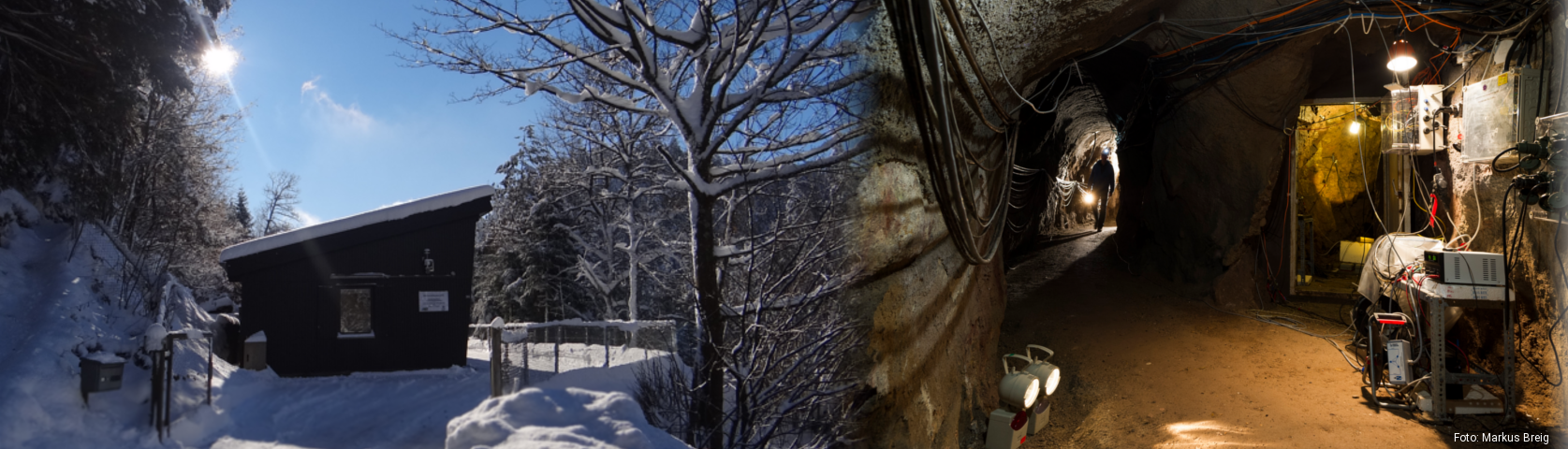
Welcome to BFO
BFO is remote and even secluded but the signals we record tell us from far away places: from earthquakes all around the globe, they tell us about the structure of the Earth's mantle and core: density heterogeneities in the mantle that drive mantle convection and plate tectonics. But with our inquiries we don't stop with planet Earth: prototypes of seismometers that have been tested here have matured and are now recording quakes on the surface of Mars. And beyond Mars? We have used gravity signals recorded here at BFO to look for signs of dark matter - an as yet elusive form of regular matter.
If all this makes you curious you are welcome at BFO!
Air-pressure fluctuations constantly load the Earth's surface, deforming the crust and disturbing sensitive seismic and rotational measurements — including the background noise of large ring lasers. Within the RING research consortium, we invite applications for a PhD position to deploy and operate a unique large-N array of autonomous barometers around the Black Forest Observatory, derive models of lateral pressure gradients, and quantify how atmospheric loading couples into crustal deformation. You will experience the full scientific cycle — from fieldwork and data analysis to modelling and publication — in an international, English-speaking environment. Join us in breaking new ground at the interface of seismology and atmospheric dynamics!
MehrWe will carry our ambitious research within the project on ’Environmental effects on long-period rotational measurements’. A large-N array of autonomous barometers will be deployed in the vicinity of Black Forest Observatory (BFO). From the such obtained data parametric descriptions of time-varying lateral gradients of air-pressure shall be derived. These gradients contribute to crustal deformation. The local rotation of sensors in the observatory is sensed as tilt-coupled gravity and shall be explained in a deterministic way by the barometric time series.
MehrWe look for student assistants (Hiwis) to support our projects. If interested, please get in touch with Thomas Forbriger.
The VBB seismometer of the NASA discovery mission InSight, that has been tested here at BFO, is now already over a year in operation on the surface of Mars recording mars quakes. Recently we detected that the seismometer has recated to a solar eclipse by the moon Phobos. While eclipses by Phobos last only 30 seconds, this was long enoght to lead to a detectable cooling and subsequent deformation of the martian surface.